How to Calculate CGPA: A Complete Step-by-Step Guide for Students
Understanding how to calculate CGPA is essential for students across schools, colleges, and universities. CGPA (Cumulative Grade Point Average) is more than just a number—it reflects your overall academic performance and plays a crucial role in admissions, scholarships, internships, and job opportunities.
Despite its importance, many students find CGPA confusing because of different grading systems, formulas, and conversion methods. This detailed guide will walk you through everything you need to know about how to calculate CGPA, including formulas, examples, semester-wise calculations, and CGPA-to-percentage conversion.
What Is CGPA?
CGPA stands for Cumulative Grade Point Average. It is the average of grade points obtained in all subjects or semesters, excluding additional subjects depending on the institution’s rules.
In simple terms:
- GPA measures performance in a single semester.
- CGPA measures performance across multiple semesters or the entire academic program.
CGPA is commonly used in:
- CBSE and ICSE schools
- Indian universities (UG and PG)
- International education systems
Why Is CGPA Important?
Before learning how to calculate CGPA, it’s important to understand why it matters:
- Academic Evaluation – Institutions use CGPA to assess student performance.
- Higher Studies – Universities often set CGPA cut-offs for admissions.
- Scholarships – Many scholarships require a minimum CGPA.
- Placements and Jobs – Recruiters use CGPA as a shortlisting criterion.
- Self-Assessment – Helps students track progress and set goals.
Understanding the Grading System
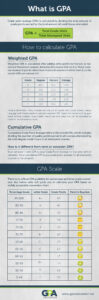
To understand how to calculate CGPA, you must first understand grade points.
Example of a 10-Point Grading System
| Grade | Marks Range | Grade Point |
| A+ | 90–100 | 10 |
| A | 80–89 | 9 |
| B+ | 70–79 | 8 |
| B | 60–69 | 7 |
| C | 50–59 | 6 |
| D | 40–49 | 5 |
| F | Below 40 | 0 |
Note: Grading systems may vary slightly between institutions.
How to Calculate CGPA: Basic Formula
The standard formula for calculating CGPA is:
CGPA = (Sum of Grade Points of All Subjects) ÷ (Total Number of Subjects)
If credits are involved, the formula changes slightly (explained later).
How to Calculate CGPA Without Credits
Let’s start with the simplest method.
Step-by-Step Method
- List all subjects.
- Note the grade point for each subject.
- Add all grade points.
- Divide the total by the number of subjects.
Example
| Subject | Grade Point |
| Mathematics | 9 |
| Physics | 8 |
| Chemistry | 7 |
| English | 9 |
| Computer Science | 10 |
Total Grade Points = 9 + 8 + 7 + 9 + 10 = 43
Number of Subjects = 5
CGPA = 43 ÷ 5 = 8.6
So, the CGPA is 8.6.
How to Calculate CGPA With Credits
Most universities follow a credit-based system, where each subject carries a certain number of credits based on workload and importance.
Formula for Credit-Based CGPA
CGPA = (Σ (Grade Point × Credits)) ÷ (Σ Credits)
Step-by-Step Example
| Subject | Grade Point | Credits | Grade Point × Credits |
| Mathematics | 9 | 4 | 36 |
| Physics | 8 | 3 | 24 |
| Chemistry | 7 | 3 | 21 |
| English | 9 | 2 | 18 |
| Computer Science | 10 | 4 | 40 |
Total (Grade Point × Credits) = 36 + 24 + 21 + 18 + 40 = 139
Total Credits = 4 + 3 + 3 + 2 + 4 = 16
CGPA = 139 ÷ 16 = 8.69
So, the CGPA is 8.69.
How to Calculate CGPA From GPA (Multiple Semesters)
If you already have GPA scores for each semester, calculating CGPA is easy.
Formula
CGPA = (Sum of GPAs of All Semesters) ÷ (Number of Semesters)
(Only applicable if each semester has equal credits)
Example
| Semester | GPA |
| Semester 1 | 8.2 |
| Semester 2 | 8.5 |
| Semester 3 | 8.8 |
| Semester 4 | 9.0 |
Total GPA = 8.2 + 8.5 + 8.8 + 9.0 = 34.5
CGPA = 34.5 ÷ 4 = 8.63
Credit-Weighted Semester CGPA
If semesters have different total credits:
CGPA = (Σ (Semester GPA × Semester Credits)) ÷ (Total Credits)
How to Calculate CGPA in CBSE
CBSE follows a 10-point grading system.
Steps
- Convert grades into grade points.
- Add grade points of five main subjects.
- Divide by 5.
Example
| Subject | Grade | Grade Point |
| English | A1 | 10 |
| Mathematics | A2 | 9 |
| Science | A2 | 9 |
| Social Science | B1 | 8 |
| Hindi | A1 | 10 |
CGPA = (10 + 9 + 9 + 8 + 10) ÷ 5 = 9.2
How to Convert CGPA to Percentage
Many institutions and employers ask for percentages instead of CGPA.
CBSE Formula
Percentage = CGPA × 9.5
Example
If CGPA = 8.6
Percentage = 8.6 × 9.5 = 81.7%
Note: Other universities may use different conversion factors like 10 or provide their own formula.
How to Calculate CGPA to Percentage in College
Some common formulas include:
- Percentage = CGPA × 10
- Percentage = CGPA × 9.5
- Percentage = (CGPA − 0.75) × 10
Always check your university guidelines before converting.
Common Mistakes Students Make While Calculating CGPA
Understanding how to calculate CGPA correctly helps avoid these common mistakes:
- Ignoring subject credits
- Using the wrong grade-point scale
- Incorrect CGPA-to-percentage conversion
- Including failed or optional subjects incorrectly
- Rounding off too early
Tips to Improve Your CGPA
Once you know how to calculate CGPA, the next step is improving it:
- Focus on high-credit subjects
- Improve consistency across semesters
- Clear backlogs early
- Attend classes regularly
- Practice past exam papers
- Seek academic help when needed
FAQs on How to Calculate CGPA
1. Is CGPA and GPA the same?
No. GPA is semester-wise, while CGPA is cumulative across semesters.
2. Can CGPA decrease?
Yes, if your performance drops in later semesters.
3. Is CGPA rounded off?
Most institutions round CGPA to two decimal places.
4. Is CGPA important for jobs?
Yes, many companies set a minimum CGPA for eligibility.
Final Thoughts
Understanding how to calculate CGPA is a fundamental academic skill that every student should master. Whether you are in school, college, or university, knowing your CGPA helps you evaluate your performance, plan improvements, and meet academic or career requirements confidently.
By following the step-by-step formulas, examples, and tips shared in this guide, you can easily calculate your CGPA accurately and avoid common mistakes. Keep track of your grades regularly, and remember—CGPA is important, but consistent learning and skill development matter just as much.